Meditation Pyramid Angles: Giza and Nubian Geometry
What is so special about Gizas and Nubians? Why are these pyramid shapes so compelling? The answer centers on one thing: the Golden Ratio and the way its harmonic angles organize space.
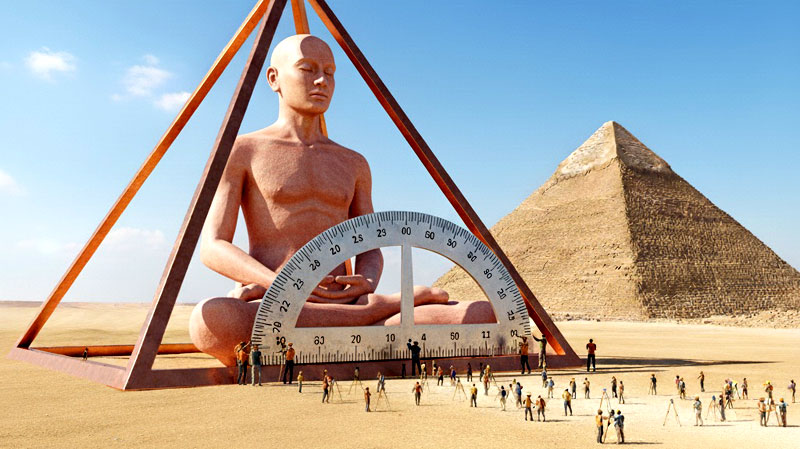
Giant in meditation pyramid w/ protractor
Both Gizas and Nubians are based on the golden ratio—a specific mathematical relationship between the lengths of the sides and the base. When we reproduce this ratio in meditation pyramids with care toward angle accuracy, many people report a distinct shift in their experience of space: breathing settles, attention gathers, and the body often feels more internally ordered.
What Is a Pyramid Angle?
When we consider what a pyramid is—especially in the context of copper meditation pyramids—we quickly notice that pyramids differ in two primary ways: the material used to construct them and the angle of their sides. This side angle, often called the “slope,” determines how the pyramid distributes space from base to apex.
There are many possible pyramid slopes, but certain angles appear to produce more consistent results in meditation settings. Two of the most well-known are the Giza slope and the Nubian slope. These angles create different spatial relationships inside the structure and are experienced differently by those who sit within them.
Two Primary Meditation Angles: Giza and Nubian


The Giza pyramid uses a slightly wider slope, creating a more grounded and expansive interior field. The Nubian pyramid uses a steeper, narrower slope, drawing attention upward toward the apex. These differences are not merely visual—they influence how space is experienced within the structure.
When combined with mindful pyramid placement and intentional stillness, these angles tend to produce the most consistent experiential results for meditation.
How Angle Influences Meditation Experience
The angle of a pyramid’s sides affects how we experience orientation, stillness, and internal focus. Many practitioners describe the Giza angle as supportive of balance and inward awareness, while the Nubian angle feels more directional or expressive in quality.
In practical terms, the Giza form often feels stabilizing for longer sessions and general use, while the Nubian form may feel more activating or clarifying for specific practices involving expression or alignment.
An Interpretive Lens: Energy Centers
Some practitioners interpret these differences through the lens of energy centers (chakras). In that framework, the Giza slope is often associated with the heart center, while the Nubian slope is associated with the throat center. This is one way of describing the experiential difference between the two forms, though it is not the only way to understand it.
In applied meditation—particularly structured pyramid meditation—these relationships are explored through direct experience rather than theory alone.
Choosing Between Giza and Nubian
Recommended Starting Geometry
For most practitioners, a Giza-style copper meditation pyramid offers a balanced and versatile experience due to its grounding spatial relationship. This is echoed in many reported effects, making it suitable for a wide range of meditation practices.
→ View Giza Copper Meditation Pyramids
Many people begin with the Giza form because of its stabilizing quality. The Nubian form is often chosen by those working more directly with expression, voice, or directional intention.
If you are unsure which to choose, you may find it helpful to read How to Choose the Right Pyramid, or explore each form in more detail on their individual use pages.
Further Exploration
To go deeper into slope accuracy, see Giza Pyramid Slope Angle. To understand the broader geometry behind both forms, visit Golden Ratio Pyramids. And for a practical introduction to working with pyramids, see First Time Use.
Understanding pyramid angles is not about theory alone. It is about recognizing how structure shapes experience. When proportion is precise, space becomes more intelligible to the body and mind. From that clarity, meditation often becomes simpler, steadier, and more direct.